


WOLF EEL
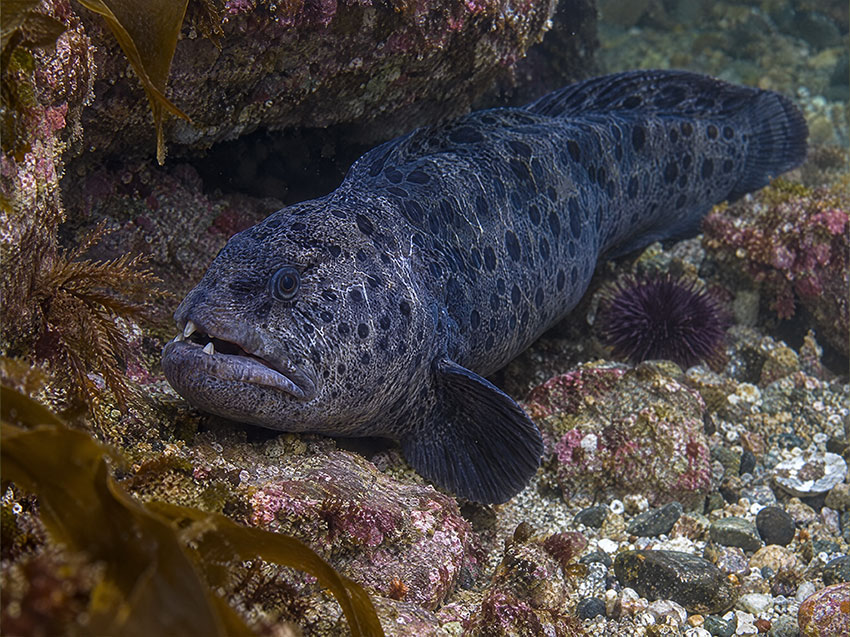
Wolf Eels are long-bodied North Pacific fish that resemble eels but actually belong to the wolffish family. Their massive jaws and strong molar-like teeth allow adults to crush crabs, clams, snails, sea urchins and other hard-shelled prey.
 Learn how to interact

ABOUT WOLF EELS
The Wolf Eel (Anarrhichthys ocellatus) is an elongated marine fish native to the North Pacific. Despite its name and snake-like appearance, it is not a true eel. It belongs to the wolffish family, Anarhichadidae.
Wolf Eels occur along rocky coasts and reefs from the Pacific coast of North America across portions of the northern Pacific. Adults commonly settle into caves and rocky crevices, where their long bodies can remain hidden while their large heads extend from the entrance.
Their most impressive tools are their jaws. Adult Wolf Eels feed heavily on hard-shelled animals including sea urchins, crabs, clams, mussels, snails and sand dollars. Strong jaws and broad crushing teeth help break through shells that many other fish cannot easily eat.
Young Wolf Eels look dramatically different from adults. Layton Aquarium notes that juveniles are orange, while adults gradually become gray. Monterey Bay Aquarium also documents this bright juvenile coloration before the fish settle into rocky habitats as they mature.
Wolf Eels also show remarkable parental care. A male and female may form a long-term pair. After eggs are laid, both adults coil around the spherical egg mass and protect it, taking turns leaving the nest to feed while the other stays behind.
Care & Conservation
Wolf Eels are currently classified as Least Concern. Their populations are considered generally stable, but healthy rocky reefs remain important because adults often spend long periods using the same shelters. Pollution, damaged reef habitat and accidental capture in fishing and crab gear can affect individual animals and local populations.
Mon-Sat 11AM-7PM Sun 12PM-6PM

PERSON!
Visit Layton Aquarium & Wildlife Encounters and discover the Wolf Eel up close.